Alleinarbeit
When employees work out of earshot and sight of other people, this is referred to as lone work.
These work situations pose specific risks:
In an emergency, direct help cannot be provided – valuable time is lost.
This is precisely where the DGUV Rule 112-139 (formerly BGR 139) comes into play. It defines clear requirements for the protection of lone workers and describes what measures companies must take.
The German Social Accident Insurance (DGUV) obliges employers to secure hazardous lone work with appropriate protective measures.
The DGUV distinguishes between:
The most important technical aid:
👉 Personal emergency signal systems (PNA)
They ensure that help is automatically alerted in an emergency.
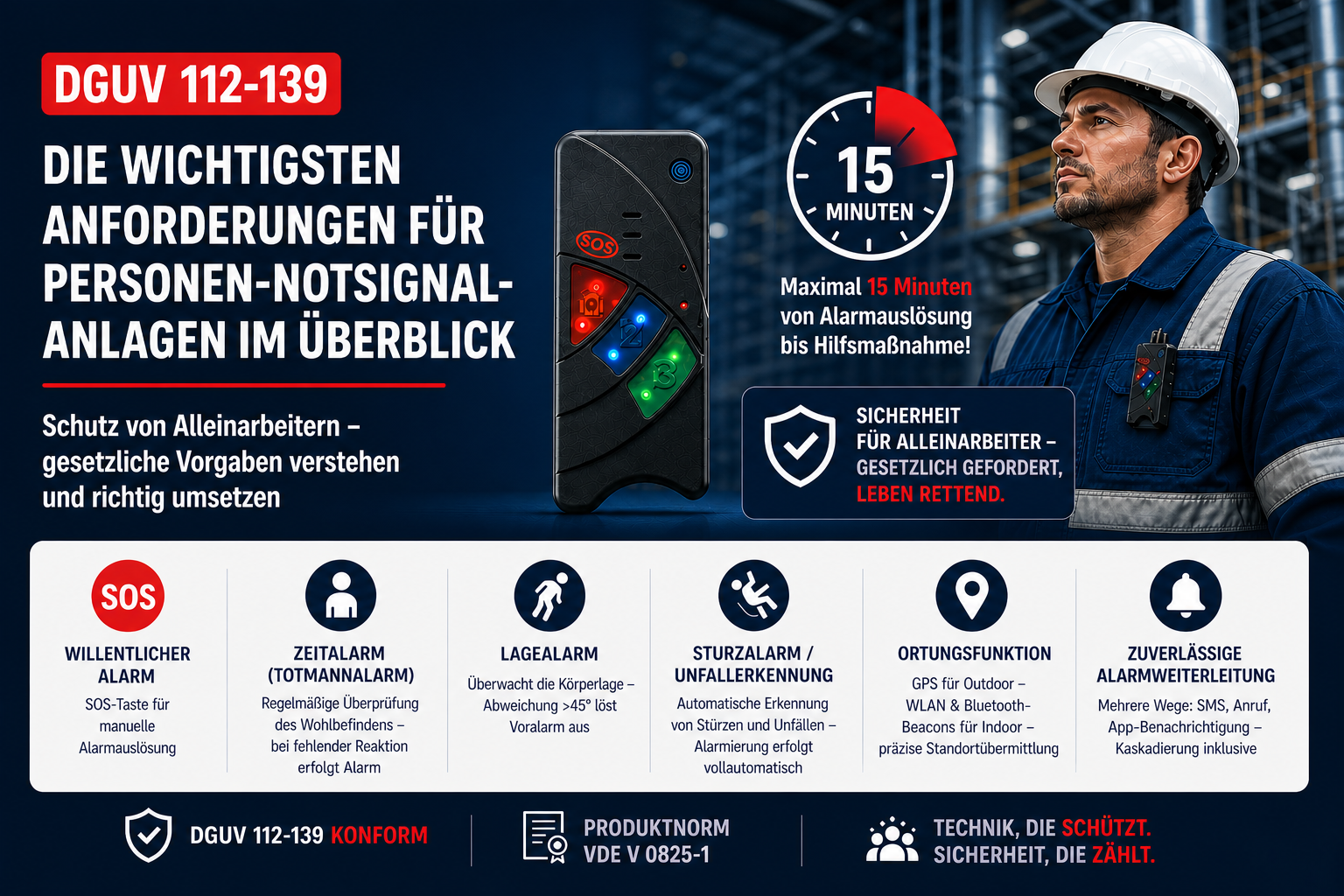
A central component of DGUV 112-139 is the so-called 15-minute rule.
It states:
A maximum of 15 minutes may elapse between an alarm being triggered and the commencement of assistance measures.
This timeframe is critical and, in an emergency, can determine the difference between severe secondary damage or even life and death.
Especially in cases of:
rapid response is essential.
![Visual – Critical lone work / Emergency]
Modern personal emergency signal systems must offer significantly more than a simple emergency call.
The DGUV defines several key functions.
The PNA must have an easily accessible SOS button.
This allows the employee to:
Once triggered, the following are automatically sent:
to stored contacts.
Particularly important:
The PNA must be able to trigger an alarm even if the affected person is no longer able to act.
The employee must regularly confirm that everything is alright.
If there is no response:
This allows unconscious or injured people to be found more quickly.
The PNA uses a position sensor to detect unusual body positions.
If a defined tilt is exceeded:
This can be life-saving, for example, in cases of:
be life-saving.
Integrated sensors detect:
fully automatically.
This alerts help, even if the affected person is no longer able to respond.
In an emergency, the employee's location must be quickly determinable.
Outdoors, location tracking is usually done via:
The position is automatically transmitted in case of an alarm.
Commonly used within buildings are:
This ensures that localization remains possible even in complex buildings.
An alarm is only effective if it is reliably received.
Modern PNA systems therefore offer:
This ensures that help can be organized quickly.
Personal emergency signal systems should be in accordance with product standard VDE V 0825-1 developed and parameterized.
This standard defines:
for professional PNA systems.
The need for a PNA is determined by the risk assessment.
Key criteria include:
PNAs are often used in:
Different solutions are suitable depending on the work environment.
Compact specialized devices such as:
offer robust hardware with all relevant alarm functions.
Advantages:
Smartphone solutions combine:
in a single device.
Particularly suitable for:
Important:
👉 Smartphone solutions and specialized devices are not in competition – the specific use case is always the deciding factor.
PNA watches like the LifeWatch series are worn directly on the wrist.
Advantages:
Ideal for employees who do not want to carry additional devices.
Special Ex-certified devices are required for hazardous areas.
These can be used, for example, in:
Investing in PNA systems is not only regulatorily sound but also economically beneficial.
Benefits:
At the same time, companies strengthen their safety culture and employer appeal.
DGUV 112-139 defines clear requirements for the protection of lone workers.
Personal emergency signaling systems help companies to:
The key is not the individual technology, but the appropriate solution for the respective area of application.
Depending on the requirements, this may include:
may be the best choice.
mobi-click supports companies with flexible solutions for modern lone worker protection – from robust specialized devices to smartphone-based PNA solutions.
👉 Get a free consultation now or try for 14 days without obligation.


.svg)
.svg)
